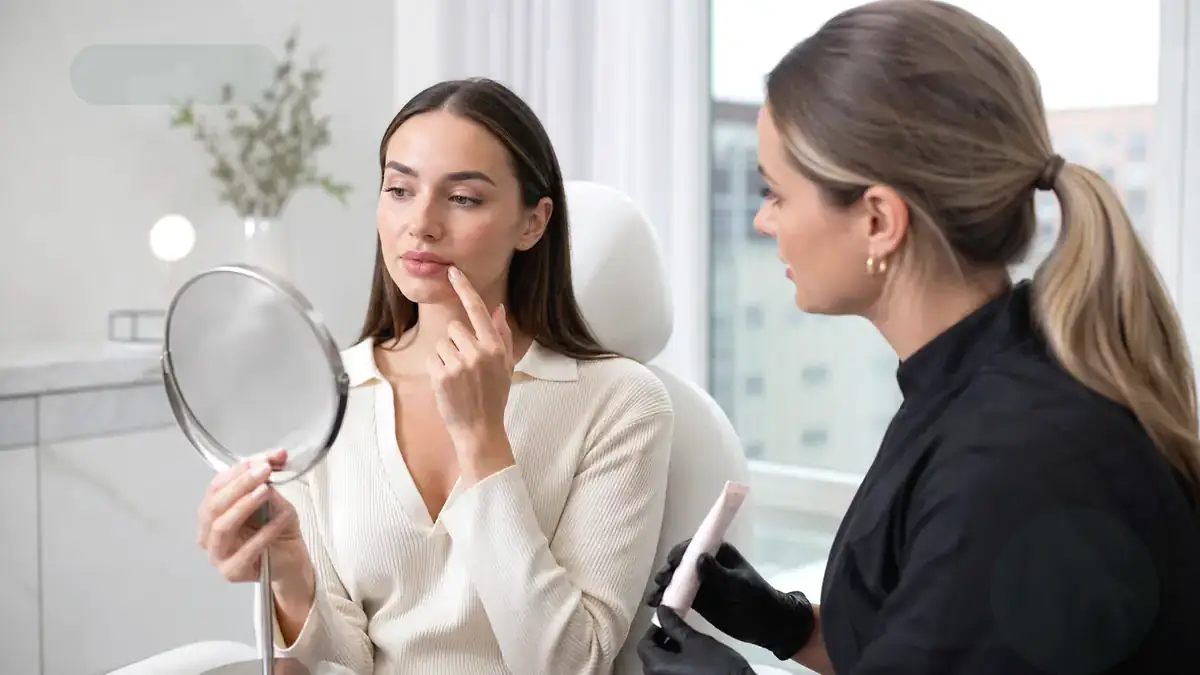
Lip augmentation with fillers is the most common aesthetic injection treatment in Sweden for people under 40. The technique has developed considerably over the past decade – from the "duck lips" that dominated the 2010s to today's focus on natural, anatomically correct results.
What is used for lip augmentation?
In Sweden, it is mainly hyaluronic acid-based fillers that are used – not permanent materials such as silicone or gel, which are sometimes used abroad. Hyaluronic acid is safe, can be adjusted and is fully reversible.
Common brands for lips
- Restylane Kysse® – specially developed for lips, soft but firm
- Juvederm Volbella® – thin consistency for subtle hydration
- Juvederm Volift® – for more volume and definition
- Teosyal Kiss® – flexible and adapted to movement
- Stylage Special Lips® – contains mannitol (an antioxidant)
- Belotero Lips® – for natural integration
Different brands have different properties – softness, longevity, lift, volume. An experienced practitioner chooses based on your goals and anatomy.
What can lip augmentation achieve?
- Volume – fuller lips
- Definition – a sharper lip border
- Symmetry – evening out natural differences
- Shape – accentuating the Cupid's bow or changing the shape
- Hydration – plumper and more moisturised lip texture
- Anti-ageing – filling in "smoker's lines" and slack corners of the lips
- Lift – lifting drooping corners of the mouth
Different techniques
Russian lips
Vertical injections from the corners of the lips towards the centre. Creates a more "lifted" and heart-shaped look. Requires a great deal of precision.
Lip filling/3D technique
Combines injections into the body and the border of the lip for a more natural 3D effect. Most common in Sweden.
Lip flip (Botox technique)
Not filler but botox – very small doses in the lip muscle make the upper lip "roll out" and look fuller. The effect is subtle and lasts 2–3 months.
Microdroplet technique
Very small droplets of filler are placed strategically for minimal swelling and natural results.
What does the treatment involve?
- Consultation – goals, anatomy, choice of filler (at least 48 hours beforehand)
- Numbing cream – applied for 20 minutes
- Marking – the practitioner marks out the injection points
- Injection – small amounts of filler are injected with a fine needle or microcannula
- Massage and inspection – for even distribution
- Ice – to reduce swelling
The whole procedure takes 30–45 minutes.
Typical doses
- Subtle "first time": 0.5 ml
- Standard volume: 1 ml
- Marked change: 1–2 ml
- Maintenance: 0.5–1 ml every 6–12 months
Less is more. A sensible practitioner starts conservatively and can always add more at the follow-up.
What can you expect?
- Visible fullness (may be dramatic due to swelling)
- Tenderness and a stinging sensation
- Possible small bruises
- Asymmetry (disappears once the swelling settles)
Week 1
- Swelling gradually decreases
- The filler "settles" into the right place
- Any small lumps soften
Week 2
- Final result visible
- Time for any touch-up
How long do lip fillers last?
The lips are one of the most active areas of the face (eating, talking, kissing), which means the filler breaks down faster than in other areas. Average duration:
- First treatment: 6–9 months
- After repeat treatments: 9–12 months
How do you avoid "duck lips"?
The dreaded "duck face" effect is usually caused by:
- Too much filler at once
- Incorrect placement – too much in the upper lip
- Too many repeat treatments without waiting until the previous filler has broken down
- Wrong choice of filler – too firm a product for a sensitive area
Our recommendation: start with 0.5–1 ml of a soft filler, wait 2 weeks and evaluate the result before adding more.
Risks and side effects
Common and transient:
- Swelling (3–7 days)
- Bruising
- Tenderness
- Temporary asymmetry
- Small lumps (usually resolve with massage)
Less common:
- Triggering of a herpes outbreak
- Allergic reaction (very rare)
- Infection
Rare but serious:
- Vascular occlusion – blockage of a blood vessel. Can lead to tissue damage if not treated urgently. This is why an experienced practitioner with in-depth anatomical knowledge is so important.
Hyalase – if the result is not what you wanted
One of the great advantages of hyaluronic acid-based lip fillers is that they can be dissolved with the enzyme hyaluronidase within a few days. This is not possible with permanent materials.