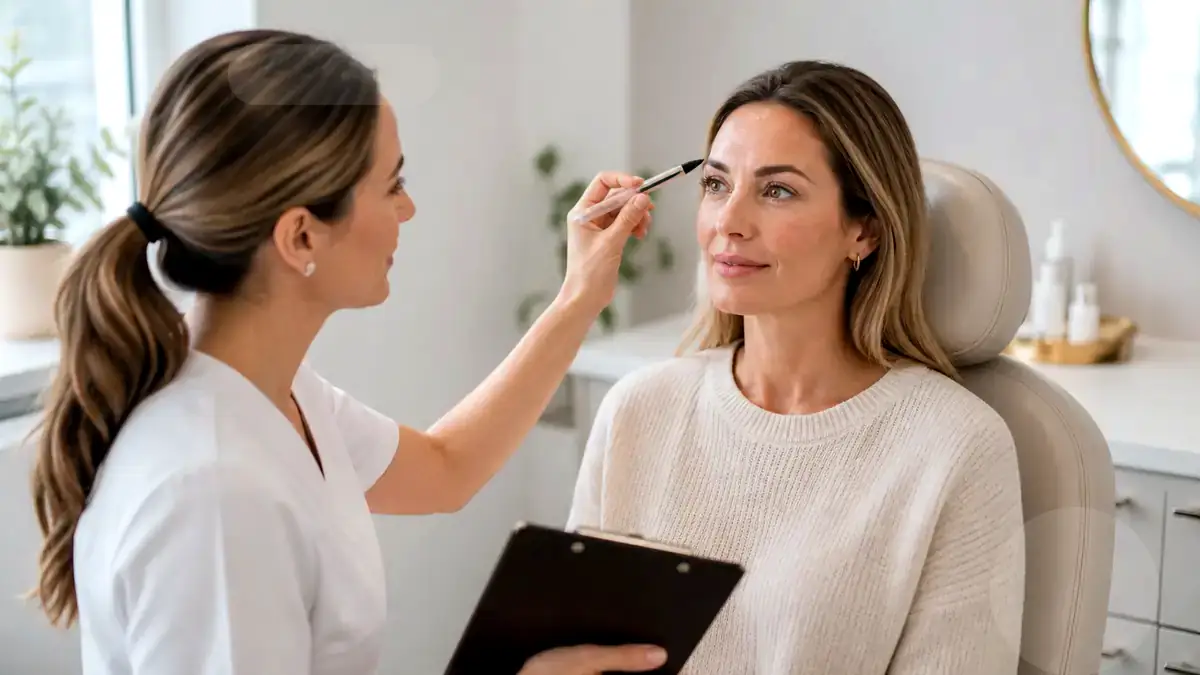
The term reputable clinic is often used without being defined. This guide shows exactly what it means in Sweden, which open sources you can use to check a clinic yourself, and which signals suggest that you should choose a different clinic.
Quick check before you book
You can verify whether a clinic is reputable in under five minutes using five open sources:
- IVO registration — search for the clinic at ivo.se/sok-vardgivare
- Licence of the person who will perform the treatment — search for the person at hosp.socialstyrelsen.se
- Organisation number — look up the clinic on allabolag.se or bolagsverket.se
- Price transparency — verified price information, no "From SEK X" trap without a ceiling
- Consultation first — reputable clinics assess you before they book you in for a treatment
The rest of the guide goes through each point in depth and shows what they do not tell you.
What does "reputable clinic" mean?
For most people it starts with a feeling — something telling you that something isn't right. Perhaps because the price seemed lower than reasonable. Perhaps because the clinic's website had nice pictures but few concrete details about who would actually perform the treatment. Perhaps because the friendly person who answered the phone avoided the question about licensure and booked you in straight away instead.
This guide is about translating that feeling into something you can actually check — in five minutes, against public registers. It is not a moral judgement of individual clinics. It is a method you can use yourself, without having to call, ask or know anyone in the industry.
When we use the expression reputable clinic in the rest of this guide, we mean a clinic that meets four basic requirements at the same time:
- Legal legitimacy — registered with IVO, has an organisation number, F-tax registration and a legally responsible counterparty.
- Professional competence — the practitioners hold the licence that the law requires for the specific treatment.
- Transparency — prices, practitioners and routines are disclosed before you book, not after.
- Patient-centred process — consultation before treatment, documented consent and a realistic assessment of what you actually need.
All four can be verified from open sources. You do not need medical knowledge to check them. The following sections show exactly how — and, just as importantly, what each source does not tell you.
Red flags: when you should say no
A clinic does not have to be perfect, but certain signals say something about how it is run. A single signal does not necessarily mean that the clinic is disreputable — the overall picture matters. These are the most common patterns among clinics that later end up in IVO cases, customer complaints or outright disputes.
1. Treatment without a prior consultation
A reputable clinic assesses you first — anatomy, skin type, medical history, expectations. If you can book directly and the clinic does not ask a single question about your health, the practitioner is either inexperienced or not following good healthcare practice.
2. "From SEK X" prices without a ceiling
The most common price trap in the aesthetics industry. "Botox from SEK 1,500" tells you nothing because the dose is the deciding factor — you may be left with a bill of SEK 4,000 after the treatment. Reputable clinics state either a verified price level (range), a price per unit or a price per area.
3. The practitioner does not state their licence
Since 1 July 2021 (Lag 2021:363), only a licensed physician, registered nurse or licensed dentist may perform injections with fillers or botox in Sweden. If the practitioner is only presented as an "aesthetic consultant" or "certified" without any mention of a licence — ask outright, or choose a different clinic.
4. Clinic without a visible organisation number
Every reputable healthcare business in Sweden has a legal domicile that can be looked up. If the website, the receipts and the invoice lack an organisation number, you have no clear counterparty to turn to if something goes wrong.
5. Before/after photos without context
Date, treatment, number of sessions, practitioner — if none of this is stated, the photo is marketing material, not documentation of results. That does not mean the photo is fake; it means it cannot be verified.
6. Large discounts with a short deadline
"40% off if you book within 24 hours" is a sales technique, not healthcare. Price pressure on the patient is a clear sign that the clinic needs volume more than it needs the right patient.
7. Polished reviews in an identical tone
Ten five-star reviews of the same length with the same phrases are not a sign of quality. They are a signal that the reviews have been collected selectively or written by people other than real customers. Look for the mixed, uneven review profile — it is more credible.
IVO registration: the clinic as a legal entity
IVO — the Health and Social Care Inspectorate — is the authority that supervises all health care in Sweden. Under the Patient Safety Act (2010:659), every care provider that carries out health care activities must register with IVO before the business starts. This also applies to aesthetic injections that are regarded as health care.
How to check the IVO registration yourself:
- Go to ivo.se/sok-vardgivare
- Search by the clinic's name or organisation number
- The result shows registered operations, addresses and the services the clinic has registered
What IVO registration does not tell you: registration is a basic prerequisite, not a quality rating. It confirms that the clinic exists as a legal care provider and has registered its operations. It says nothing about individual practitioners' licences, whether prices are reasonable or whether results tend to be successful.
If IVO has made a decision about the clinic: bans (suspension of operations), conditional fines or other measures are public documents, and if you search for the clinic's name on ivo.se you will find them. An active ban is a strong signal to investigate the business very carefully before treatment.
Licensed practitioner: who is actually allowed to inject
In Sweden, only a licensed physician, registered nurse or licensed dentist has been permitted to perform injections with fillers or botulinum toxin since 1 July 2021 (Lag 2021:363 on aesthetic surgical procedures and aesthetic injection treatments). An "aesthetic consultant", "certified practitioner" or "in-house trained" person is not enough — it is a legal requirement.
How to check the licence yourself:
- Go to hosp.socialstyrelsen.se
- Search by the practitioner's first name and surname
- The result shows the professional title, the date of the licence and any restrictions or revocations
Ask the clinic who will perform your treatment and what licence that person holds. A reputable clinic answers straight away and often has the licence details visible on its own website. If you have to repeat the question several times or get vague answers — move on.
An important nuance: a skin therapist or assistant nurse can be skilled and reputable in their field (laser, dermapen, peels, skincare) but is not allowed to inject. That does not mean the clinic is disreputable — it means you need to know which member of staff does what.
Patient insurance and liability insurance
These are two different types of insurance, and a reputable clinic may have both. They protect different things.
Patient insurance is mandatory under the Patient Injury Act (1996:799). It covers injuries that occur in connection with care and is taken out with, for example, Folksam, Trygg-Hansa or Länsförsäkringar. If the clinic lacks patient insurance, it is breaking the law.
Liability insurance is a general business insurance that covers third-party damage, e.g. physical damage to premises, equipment or property. It is not required by law but is common.
How to check: reputable clinics state their insurer on their own website, usually on /om-oss (about us) or in their terms and conditions. If the information is missing, you can ask the clinic directly — the answer should come in writing, with the insurer and the policy number.
An important nuance: the fact that a clinic only mentions "patient insurance" does not mean it lacks liability insurance — it means it has only mentioned what the law requires. If you want to know about both, ask.
Organisation number and Bolagsverket
Every reputable clinic in Sweden has a ten-digit organisation number that identifies the legal entity behind the business. This is your legal counterparty if something goes wrong — an invoice, a complaint or a court case is based on this number.
How to check:
- Look up the clinic's name or organisation number on allabolag.se or bolagsverket.se
- Check that the company is active (not in liquidation, bankrupt or dormant)
- Check for F-tax — this confirms that the company is registered for business activity and pays tax. A clinic without F-tax operates outside the formal system.
- Note the board and authorised signatories — if a "medically responsible" person is stated on the clinic's website, that person should reasonably appear in some role here.
If the website lacks an organisation number entirely, or it only appears in small print at the very bottom and cannot be found directly, that is a signal — not proof, but a signal — that the clinic is not fully transparent about its legal identity.
Medically responsible person
Under the Health and Medical Services Act (2017:30), a healthcare business in Sweden must have a head of operations (verksamhetschef) who has overall medical responsibility. For aesthetic injection treatments, the legislation from 1 July 2021 (Lag 2021:363) has further tightened the requirements for medical competence.
What a reputable clinic should be able to answer:
- Who is medically responsible at the clinic?
- What licence does that person hold (physician, nurse, dentist)?
- Is the person available for consultation or only administratively responsible?
The question is not complicated. A clinic that hesitates, answers vaguely or refers you elsewhere has, in doing so, answered your question for you.
Price transparency
Price transparency is one of the clearest ways to tell reputable clinics apart from the rest — for a simple reason: stating prices clearly requires the clinic to know exactly what it offers and to have the confidence to stand behind it.
What a price-transparent clinic shows:
- Verified price range per treatment (e.g. "Botox SEK 1,800–3,500 depending on dose") or price per unit
- Consultation fee — free or charged, stated before you book
- Correction cost — if the result needs adjusting within a certain time, what does it cost? (Some clinics include it; others charge the full price.)
- Cancellation rules — when do you have to cancel, and what happens if you don't turn up?
What price transparency is not:
- "Price after consultation" — without any range — is not transparency, it is salesmanship
- "From SEK X" without a ceiling is not a price, it is an enticing figure
- Long-running discount campaigns ("always 30% off") signal that the original price was not genuine
If you are comparing prices between clinics, compare verified ranges, not entry prices.
The consultation
The consultation is often the single most important meeting in the whole process. A proper consultation has the following components:
- Review of medical history — allergies, medicines, previous treatments, pregnancy, autoimmune conditions
- Anatomical assessment — what is realistic for your particular face, skin or area
- Discussion of expectations — what you hope for vs what the treatment can actually deliver
- Discussion of risks — known side effects, unusual side effects, what to do if something happens
- Aftercare — instructions, timeline, when to contact the clinic
- Written consent — you read it, sign it and receive a copy
- Cooling-off period — the opportunity to think the decision over without booking treatment on the same day
The last point is often decisive. A reputable clinic wants you to make the decision with a clear head. A clinic that pressures you to book straight after the consultation — or offers a discount if you do — is prioritising volume over the right patient.
Before/after photos and reviews
Both are useful — if you read them correctly.
Before/after photos you can trust
- Same angle, same lighting, same expression
- Dates for both photos
- Treatment and number of sessions are stated
- The practitioner is named
- The time between the photos (2 weeks, 6 months) is stated
Photos without this information are marketing, not documentation of results. That does not mean the result is untrue — it means you cannot verify it.
Reviews you can trust
- Mixed profile — 4.2–4.8 with a few threes is more credible than nothing but fives. Real customers have different experiences.
- Reviews with names and concrete details are stronger than anonymous ones
- Google and Bokadirekt together — check both. A clinic that has 4.8 on its own website but 3.5 on Google has a discrepancy worth investigating.
- Beware of an identical tone — if ten reviews have the same length, the same phrases and the same structure, they have probably been collected selectively or written by the same person.
Complete checklist
Before booking
- The clinic is registered with IVO (verified on ivo.se)
- No active IVO decisions (bans, conditional fines) — searched on ivo.se
- The practitioner is licensed for the specific treatment — verified on hosp.socialstyrelsen.se
- The clinic's organisation number is on the website and can be looked up on allabolag.se
- Registered for F-tax
- Patient insurance mentioned on the clinic's own website
- Price stated — verified range or price per unit, no "From SEK X" trap
- The medically responsible person is named, with their licence
At the consultation
- Your medical history was reviewed
- Risks were discussed
- Written consent was given and you received a copy
- You were given a cooling-off period — you were not pressured to book on the same day
After the treatment
- You received aftercare instructions in writing
- You know whom to contact if something happens
- You have kept the receipt and consent documents
Some people also choose to prepare with a personal skincare analysis before the consultation — so that they go in with a better basis for what their skin actually needs. hudkollen.se offers such an analysis.